

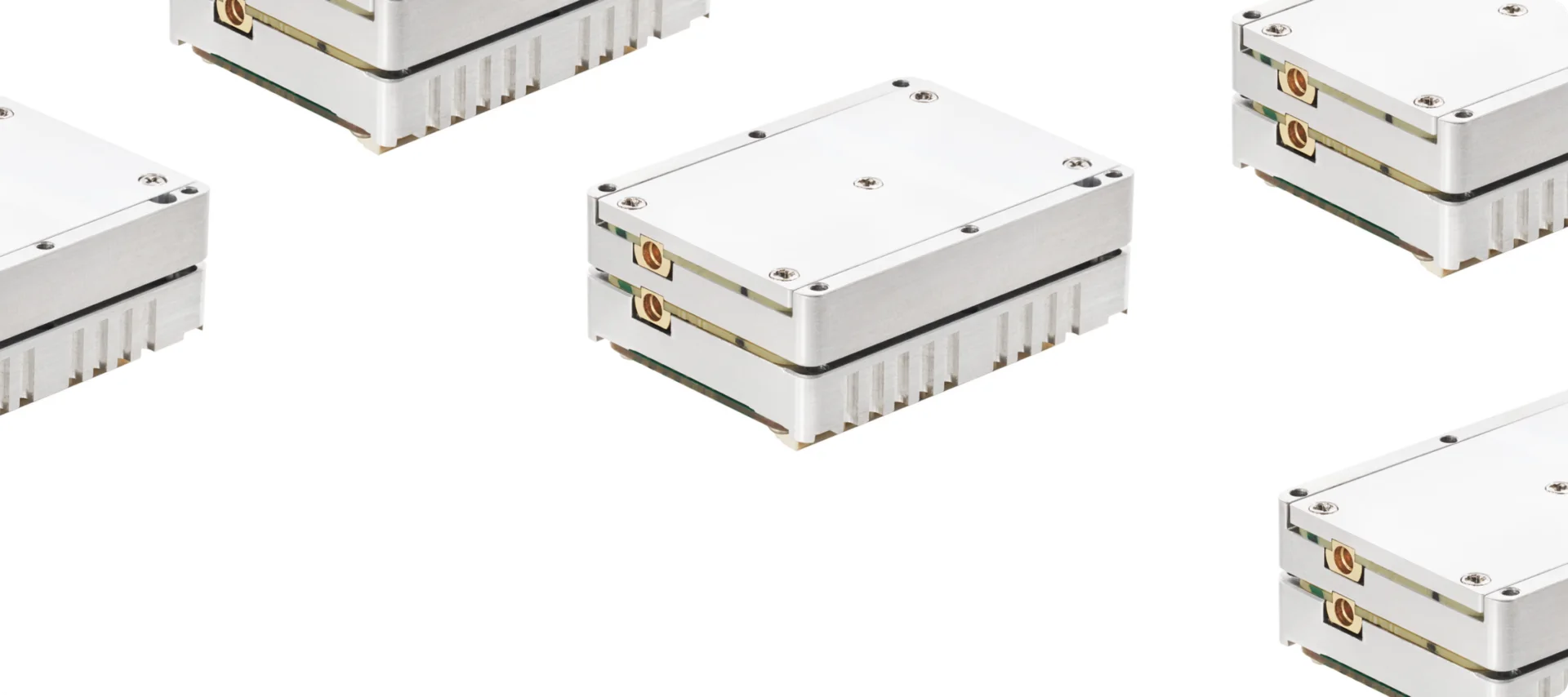
Introducing Mesh Rider® Dual Radio: Two independent bands. One unbreakable link.
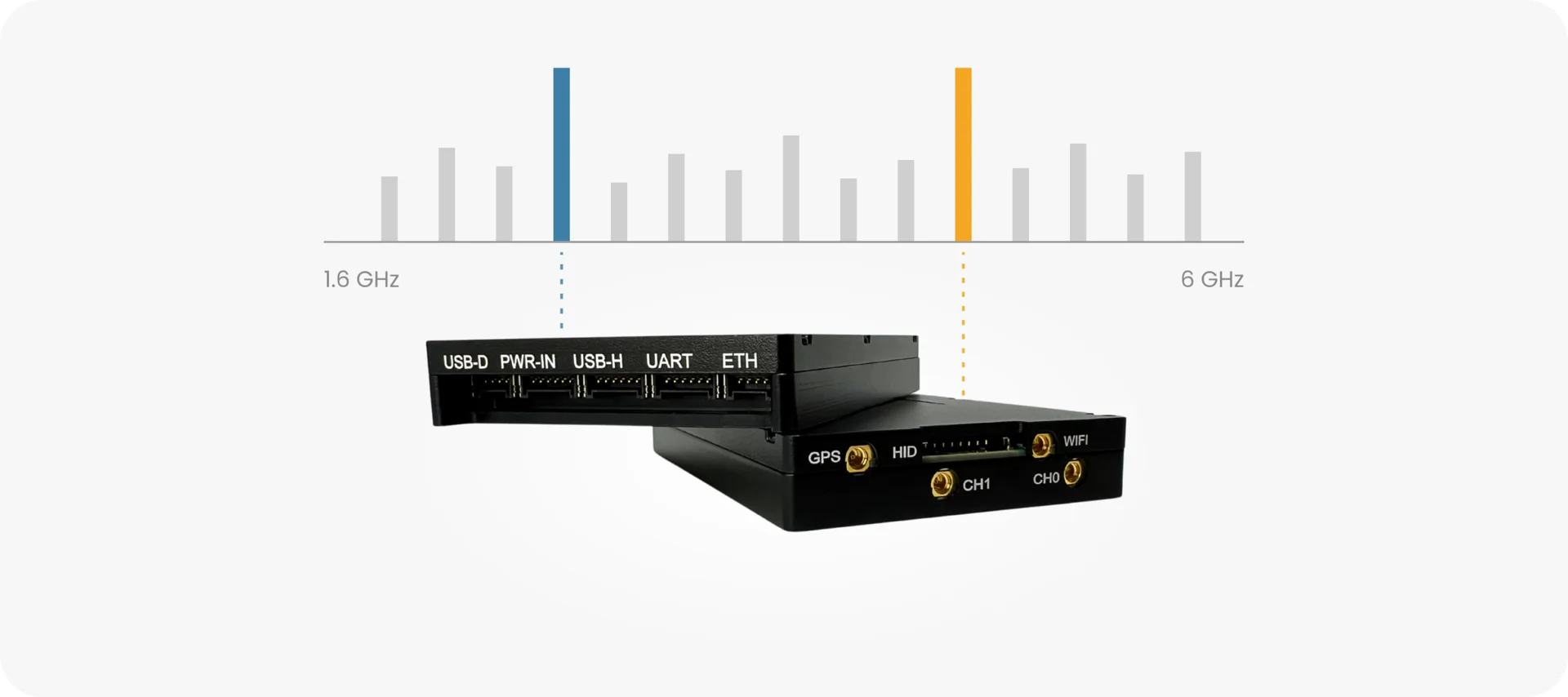
Doodle Labs introduces Mesh Rider® Dual Radio, a new radio kit that pairs two independent OEM radio modules on separate frequency bands inside a single node. Dual Radio is built for teams operating in the most contested radio-frequency environments, where a single-band radio, however capable, still carries one point of failure: the band itself.
Limits of single-band frequency agility
Most anti-jamming approaches rely on frequency agility. When a radio detects interference, it moves to a cleaner channel within its band. Doodle Labs’ radios already achieve this through Sense EW, our proprietary frequency agility engine, as part of the broader electronic warfare resilience built into Mesh Rider hardware. And the solution holds up well against a wide range of real-world jamming.
However, it does have a structural limit. A broadband jammer that denies an entire band leaves the radio nowhere to hop. Similarly, a tracking jammer built to follow an active transmission, if fast enough, can keep pace with a single radio’s frequency changes. In both cases, the underlying problem remains the same: everything depends on one band.
What Dual Radio adds
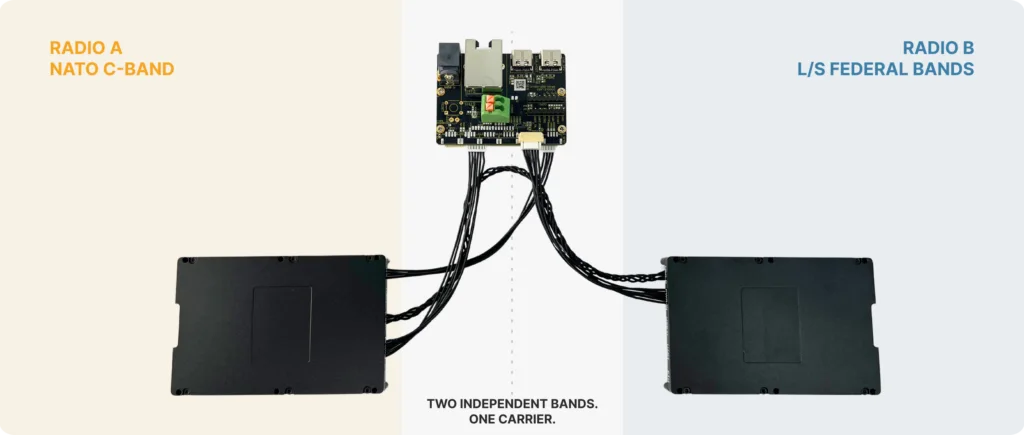
Dual Radio addresses the band limitation by combining two independent Mesh Rider OEM radio modules into a single integrated node. While one module covers L/S Federal bands, the other one covers NATO C-band and upper government bands. The two are physically and spectrally separate, which is the basis of the system’s resilience: an adversary can defeat a band but not the link.
The dual band is further strengthened with each radio running its own instance of Sense independently, continuously scanning its own band and relocating to cleaner spectrum without waiting on the other radio to degrade first. Our Dynamic Mesh firmware, purpose-built for this dual-radio architecture, manages failover between the two links with no measurable delay. In practice, if one band goes down, it does not mean the link goes down.
The kit ships ready to integrate: two Mesh Rider OEM modules, a wire harness, and Dual-Radio Dynamic Mesh firmware pre-loaded. Because it’s built on the existing Mesh Rider OEM platform, integrators already working with that radio have a head start on the footprint and interfaces involved.
Three ways to use the second band
Dual Radio supports three operating modes, and the right one depends on the threat a team is facing.
- Redundancy mode runs both radios simultaneously, each carrying live traffic on its own band. If one band is fully denied, traffic continues on the other with zero-millisecond failover and no operator intervention.
- Multiband relay mode uses one radio to receive on its band while the second retransmits on the other, turning the node into a transparent repeater. A single-radio mesh can already relay traffic, but each hop shares one band, half-duplex, which cuts throughput at every hop, and closing a terrain or line-of-sight gap still means placing a dedicated relay unit in that gap. Dual Radio pairs two Mesh Rider OEM radio modules in one kit, so the node relays itself, extending range and beyond-line-of-sight coverage without a separate relay unit or throughput penalty.
- Spoofing and deception mode dedicates one radio to broadcasting a decoy signal designed to attract and hold a tracking jammer’s attention, while the second radio carries real traffic undetected on the other band.
Because each mode addresses a different threat, a team can choose the one that matches its operating environment rather than relying on a single defense node.
Hardware, specifications, and content kit
Each radio in the Dual Radio kit delivers up to 80 Mbps of throughput with 2×2 MIMO and up to 1.6 watts, or 32 dBm, of transmit power. Command and control traffic runs at 1.5 to 10 millisecond latency over Doodle Labs’ Ultra-Reliable Low Latency Channel. Encryption is available at 128-bit AES for full throughput or 256-bit AES.
On the hardware side, each radio module measures 57 x 86 x 13 millimeters, weighs 102 grams, and draws 6 to 24 volts DC and are built to MIL-STD-810H shock and vibration standards. The evaluation kit ships under part number DR-2025-5200-69O3, and band combinations beyond the standard L/S and C-band configuration are available on request.
Dual Radio’s fit in Mesh Rider lineup
Dual Radio is one part of a broader set of resilience tools Doodle Labs builds into the Mesh Rider platform, alongside the multi-band radio lineup and Sense EW itself. The multi-band portfolio and Sense EW address the baseline of electronic warfare that most deployments face every day. Dual Radio, by contrast, is built for what sits above that baseline: a broadband adversary capable of denying an entire band, or a tracking jammer sophisticated enough to follow frequency-agile transmissions on its own.
Teams already using Mesh Rider OEM radios in electronically contested deployments are the most likely beneficiaries of Dual Radio, particularly where a single point of RF failure is not an acceptable risk. Because the kit is built on that same OEM platform, it integrates into a familiar physical and electrical footprint, which shortens the evaluation process for teams that already know the hardware.
“Jam one band. The mission continues on the other.”
Talk to Doodle Labs
Mesh Rider Dual Radio gives integrators a way to remove the single-band vulnerability that most systems still carry. Two independent bands, two independent jamming defenses, and a dedicated deception mode combine to keep the link up when a single-band radio would already have gone dark.
To evaluate Dual Radio for your platform, contact the Doodle Labs team and request an evaluation kit, or visit the Mesh Rider products page to see how Dual Radio fits alongside the rest of the lineup.