

Analog, digital or fiber? Choosing resilient FPV drone communications
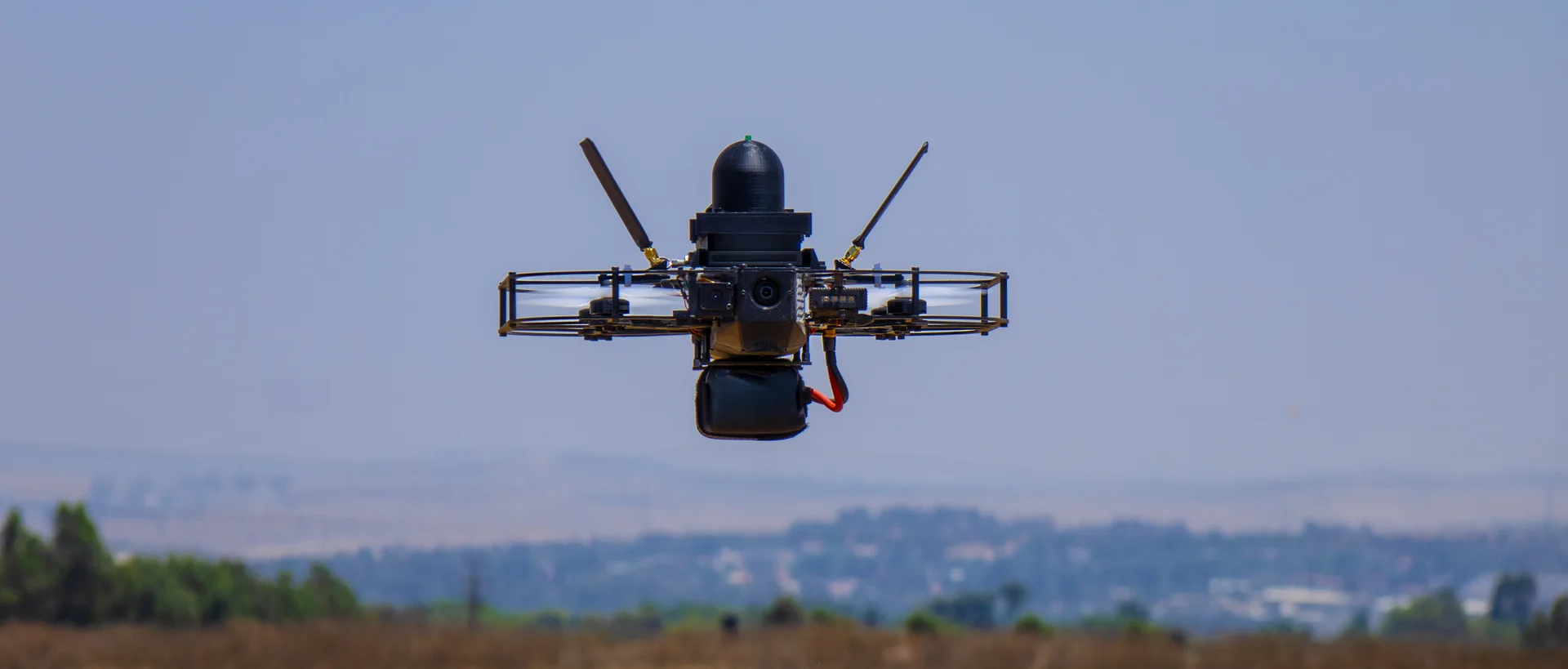
FPV drone communications have changed considerably in the past few years. Analog video remains widely used because of its low cost and latency. Fiber-optic systems have gained ground in environments where radio frequency (RF) interference makes conventional links unreliable. Digital systems have narrowed the latency gap while adding capabilities that are increasingly important for defense and commercial applications.
Each has advantages. The challenge for drone manufacturers is understanding which tradeoffs matter for the intended mission.
That decision has become more complicated as electronic warfare systems evolve. Maintaining a usable video feed and control link now requires more than selecting a transmitter with enough range. Communications resilience, security and the ability to adapt to changing conditions all factor into the choice.
What makes an FPV communications link resilient?
Every FPV drone depends on two critical communications functions. The control link carries commands from the operator to the aircraft, while the video downlink returns the camera feed that allows the pilot to navigate.
Both must perform reliably, and both are sensitive to delays and interference.
Latency remains especially important for FPV operations. A pilot flying manually needs immediate visual feedback to make corrections. But low latency alone doesn't guarantee a reliable connection.
A system that performs well in clear RF conditions may struggle when other transmitters compete for spectrum, or an adversary actively targets the link.
Resilience describes the ability to maintain or recover communications under those conditions. How a system achieves it depends on the technology behind it. Start writing your article here.
Analog FPV: Simple, fast and inexpensive
Analog has been central to the growth of FPV drones, particularly low-cost and attritable platforms.
Its appeal is straightforward. Analog video transmitters are inexpensive, integration is relatively simple, and latency is low enough for highly responsive manual flight.
Analog also has a useful characteristic when signal quality deteriorates. The picture typically becomes progressively noisier rather than disappearing immediately. An experienced pilot can sometimes continue operating through interference.
The limitations become more apparent in contested environments.
Traditional analog FPV video is unencrypted, allowing anyone with a compatible receiver to view the transmission. Fixed-frequency analog links are also vulnerable to jamming, with limited options for adapting when their operating channel becomes unusable.
Analog video systems also lack the ability to carry the broader combination of encrypted video, telemetry and networked data expected of modern digital communications architectures.
For inexpensive FPV drones operating in relatively predictable conditions, analog remains a practical choice. Missions requiring secure communications, greater interference resistance or coordination across multiple platforms place additional demands on the system.
Fiber-optic FPV: Resilience without RF transmissions
Fiber-optic FPV systems take a different approach to communications resilience.
Instead of transmitting video and control information wirelessly, they carry those signals over a physical cable between the aircraft and operator.
This eliminates exposure of the communications link to conventional RF jamming and interception. In heavily contested environments, that can be a significant advantage.
The tradeoff is mobility.
A fiber-optic drone must carry a spool of cable, which limits its operating range and introduces physical constraints on maneuvering. The tether also prevents the aircraft from participating in the same kind of freely moving wireless network as a radio-connected platform.
Cable availability, cost and deployment logistics add further considerations, particularly for manufacturers building large numbers of attritable systems.
Fiber is well suited to missions where avoiding RF interference takes priority over mobility and network flexibility. It becomes less practical when aircraft need to maneuver without a tether or communicate dynamically with other vehicles and ground nodes.
Digital FPV: Low latency with more room to adapt
Digital FPV communications have advanced significantly from earlier systems that introduced noticeable video delays.
Modern digital video platforms can now deliver latency approaching analog performance while supporting higher-resolution video and encrypted transmission.
That development has changed the engineering decision.
For many applications, the remaining latency difference is small enough to consider the additional capabilities available through digital communications.
Those capabilities extend beyond the video feed, although they depend on the specific radio system.
Frequency-agile digital radios can change channels or operating bands as interference conditions evolve. Adaptive transmission techniques can help manage changing link quality, while mesh-capable architectures allow communications to pass between multiple aircraft and ground nodes.
Digital links can also carry video, command-and-control information, telemetry and additional payload data over a common communications architecture.
These are important distinctions for FPV programs moving beyond basic point-to-point video transmission.
Digital is still an RF technology and remains susceptible to interference. Video performance can also deteriorate quickly when a link reaches its operating limits. Its advantage comes from the additional ways a properly designed digital system can respond to changing conditions.
Choosing the right FPV communications technology
The appropriate technology depends on what the aircraft must do and the conditions it will encounter.
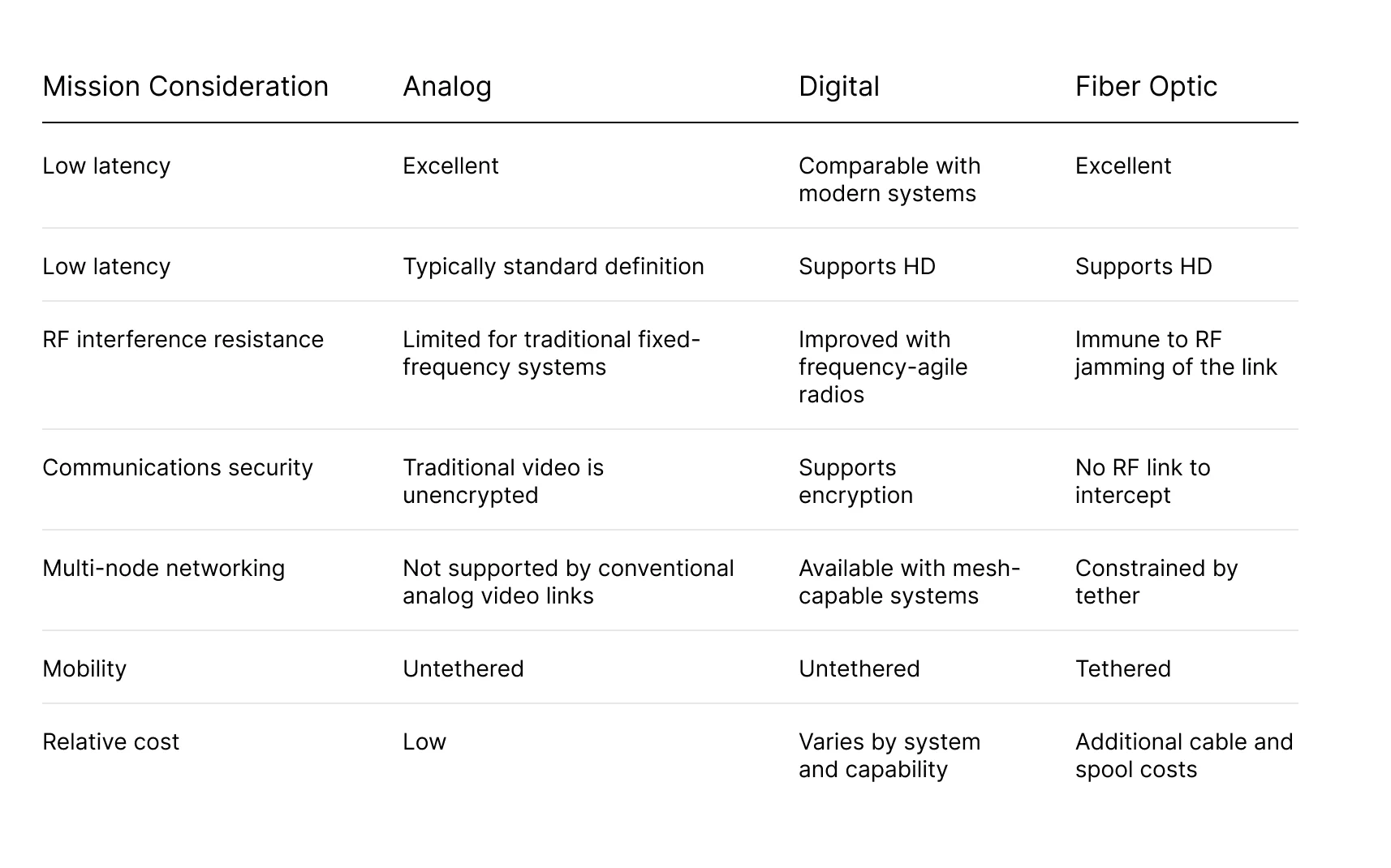
For a low-cost, short-range FPV platform, analog may meet the requirements without additional complexity.
Fiber may be preferable when the mission requires a communications link unaffected by RF jamming and can accommodate a physical tether.
Digital becomes particularly relevant when the mission requires secure video and control, adaptive RF operation, telemetry and coordination with other systems.
These decisions also extend into the aircraft's lifecycle. Component availability, compliance, SWaP requirements and production scalability can influence whether a communications architecture remains viable as a program grows.
Communications resilience starts with the mission
Analog, digital and fiber-optic FPV systems each address different operating requirements.
- Analog remains practical for low-cost, short-range platforms where simplicity and responsive video are the priorities.
- Fiber optic provides reliable communications without exposure to RF jamming, although the physical tether limits mobility and network flexibility.
- Digital offers greater flexibility for platforms requiring secure video and control, adaptive RF operation and coordination with other systems. Those capabilities depend on the underlying radio architecture.

The experience in Ukraine has shown how quickly operating conditions can change. Frequencies become contested, interference increases and systems that perform well in one environment may struggle in another.
For OEMs developing the next generation of FPV platforms, the decision comes down to the mission requirements, the tradeoffs each technology introduces and whether the communications architecture can adapt as conditions change.
For a deeper examination of the technologies, performance data and lessons from Ukraine, read the Doodle Labs and ModalAI joint whitepaper, Why Digital Wins: FPV Drone Communications in Contested Environments.