


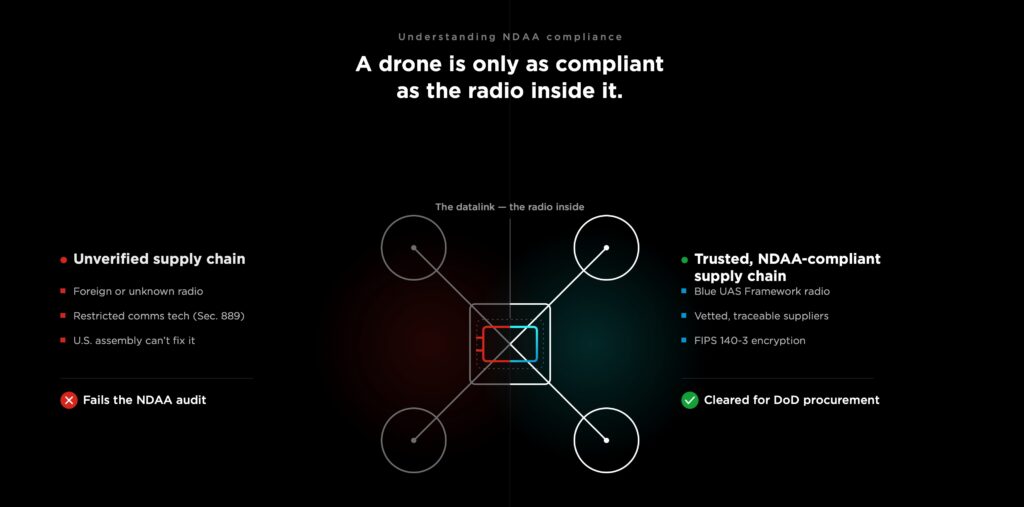
When a drone program fails an NDAA compliance check, the problem is rarely the airframe. It’s almost always something on the inside – and more often than not, it’s the radio.
This isn’t a coincidence. The federal restrictions that govern unmanned systems were written around communications and surveillance hardware first, and drones second. The datalink, the radio that carries command, control, and video between the aircraft and the ground, sits squarely in the middle of that concern. It is the component most directly governed by the law, the one most likely to introduce restricted technology, and the one procurement officers scrutinize first.
For drone manufacturers, system integrators, and the agencies that buy from them, this leads to a single conclusion: NDAA compliance is decided at the datalink. Get the radio right, and the rest of the platform has a clear path to approval. Get it wrong, and no amount of domestic assembly will keep the system from disqualification.
What Is NDAA Compliance?
The National Defense Authorization Act (NDAA) is the annual U.S. law that authorizes funding and sets policy for the Department of Defense (DoD). Over several years, Congress has used it to restrict federal use of telecommunications, video surveillance, and unmanned hardware tied to specific foreign suppliers, considered national security risks.
It’s worth separating the provisions that apply to drones, because they originate in different places and are often blurred together:
- Section 889 (FY2019 NDAA) is the telecommunications and video surveillance provision. It prohibits federal agencies and their contractors from procuring equipment or services from five named Chinese companies – Huawei, ZTE, Hytera, Hikvision, and Dahua – or any system that uses their technology as a substantial or essential component. This is the provision that reaches the datalink most directly, because a radio is, by definition, telecommunications equipment.
- Section 848 (FY2020 NDAA) and the American Security Drone Act (FY2024 NDAA) are the drone-specific provisions. Together they prohibit federal agencies from procuring or operating drones that containcomponents from covered foreign manufacturers. The American Security Drone Act expanded those restrictions government-wide, with full enforcement that began December 22, 2025.
The practical effect is the same regardless of which section applies: a drone is only as compliant as the parts inside it. An airframe assembled in the U.S. but carrying a foreign-made radio is not NDAA compliant. Compliance is a property of the bill of materials – not the label on the box.
So, when a system is described as NDAA compliant, it should mean that its components and suppliers:
- Contain no restricted communications or video-transmission technology
- Come from vetted suppliers with a documented, traceable supply chain
- Meet federal acquisition requirements
- Qualify for government-funded programs without introducing compliance risk
NDAA, Blue UAS, and Green UAS: How They Fit Together
NDAA compliance is the legal baseline. The Blue UAS and Green UAS programs are how the DoD verifies it – and the distinction matters, because buyers and integrators routinely use the terms interchangeably when they mean very different things.
- The Blue UAS Cleared List is a roster of complete, ready-to-fly drone platforms validated as NDAA-compliant and cyber-secure, approved for DoD purchase and operation.
- The Blue UAS Framework is the component-level counterpart: a list of vetted, interoperable, NDAA-aligned components and software – radios, flight controllers, payloads, ground control software – that integrators can build with, confident each piece will pass when properly configured.
- Green UAS, administered by AUVSI, is a recognized third-party assessment pathway for components and platforms, often serving as a steppingstone towards the Blue UAS Framework or Cleared List.
For component makers and integrators, the Framework is the one that matters most. It’s where a datalink earns its credentials, and it’s what lets a drone manufacturer assemble a compliant system from pre-vetted parts instead of re-proving every component from scratch.
One shift is reshaping the landscape – in December 2025, oversight of Blue UAS moved from the Defense Innovation Unit (DIU) to the Defense Contract Management Agency (DCMA). That turned Blue UAS from a fast innovation evaluation into a formal acquisition compliance function – complete with production audits, supply-chain surveillance, and a higher bar for staying on the list, not just getting on it. Around the same time, the FCC added foreign-made drones to its Covered List, blocking new DJI and Autel models from receiving U.S. authorization. The direction is unmistakable: the compliance bar is rising, and it is being enforced harder.
Why NDAA Compliance Matters for Drone Buyers
For organizations procuring drones for government, defense, or critical-infrastructure missions, compliance is now a procurement gate – not a nice-to-have. It addresses four priorities buyers can’t afford to overlook:
- Trusted supply chains. Compliance confirms that every component – especially the datalink – comes from vetted suppliers with traceable provenance, closing the supply-chain and cybersecurity gaps the law was written to address.
- Reduced program risk. Non-compliant equipment in a regulated program invites delays, added cost, and outright disqualification during audit. Compliant systems clear procurement and audit checks the first time.
- Eligibility for funded programs. Federal agencies, defense contractors, and grant-funded projects increasingly require NDAA compliance as a condition of selection. Meeting the standard keeps a platform eligible for the budgets that matter.
- Long-term lifecycle support. As enforcement tightens, compliant systems stay viable. Non-compliant ones face costly redesigns, retrofits, or removal as deadlines like the December 2025 enforcement date take effect.
Notice that the datalink touches all four. It is the component most exposed to Section 889, the one most likely to trigger an audit finding, and the hardest to swap late in a design cycle. Choosing a compliant radio early is the single most effective way to de-risk a program.
Compliance Is Our Baseline, Not A Milestone
At Doodle Labs, we treat compliance as baseline readiness, not a future milestone.
We developed our Mesh Rider® Radios with sponsorship from the DoD’s Defense Innovation Unit and AFWERX for the Blue UAS program, and they sit on the Blue UAS Framework cleared components list – cleared for DoD and international use. Our radios run FIPS 140-3 encryption and are built on Qualcomm chipsets with a standards-based, Linux-based architecture that lets other Blue-cleared vendors integrate deeply and quickly.
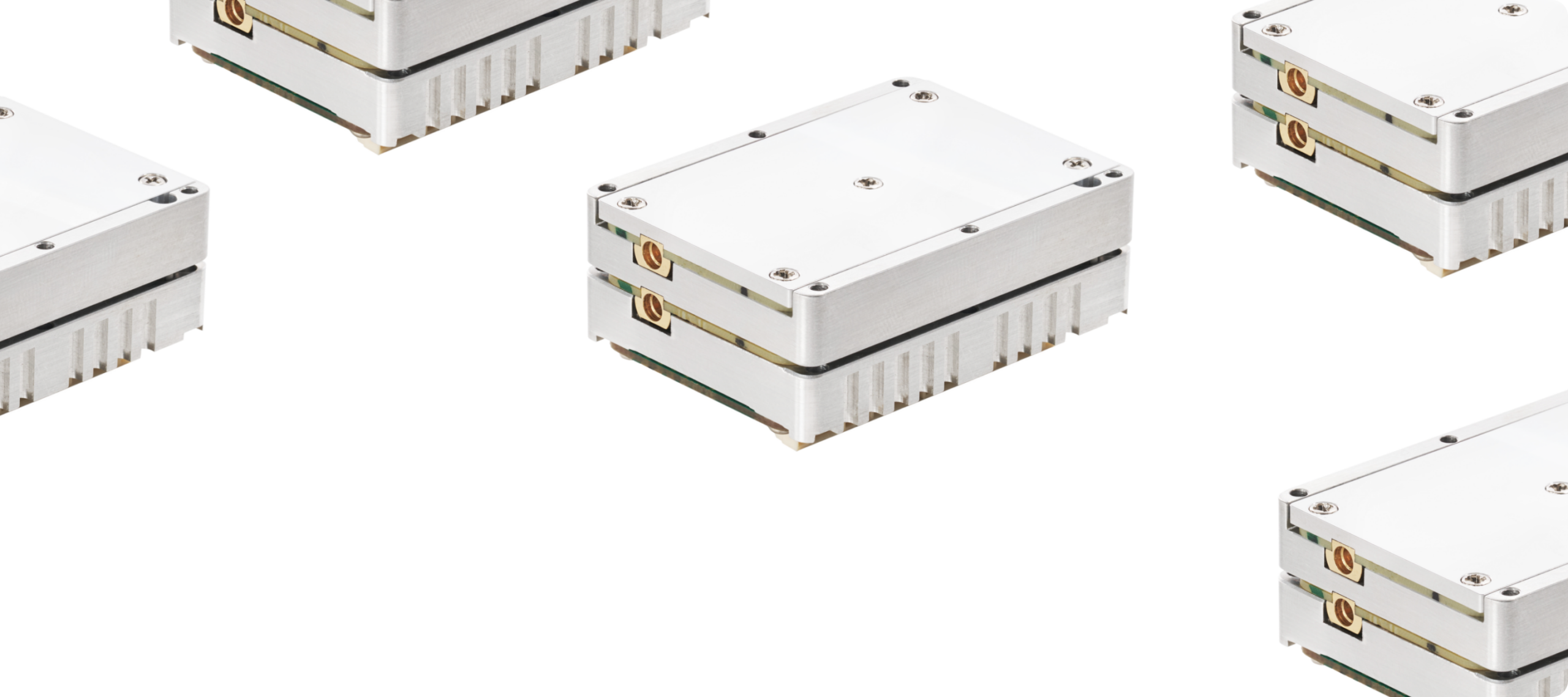
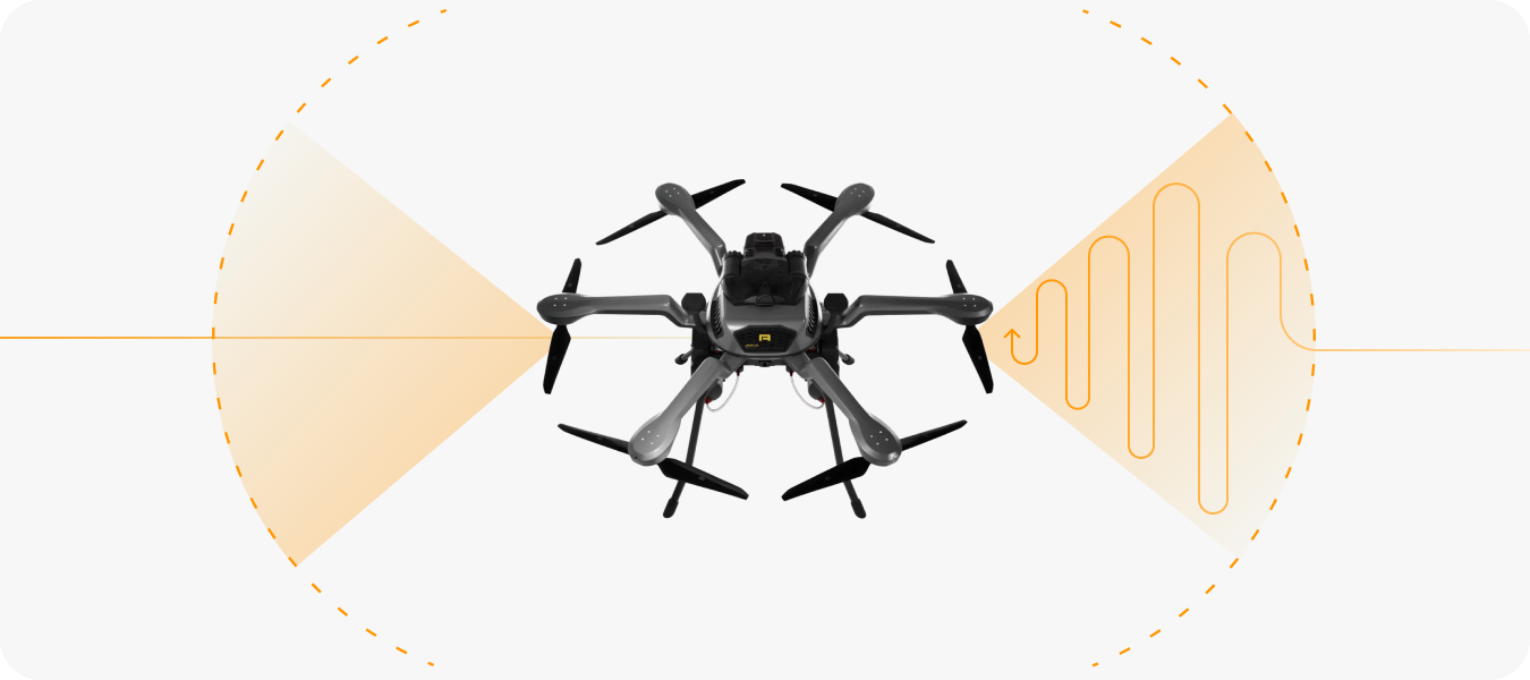
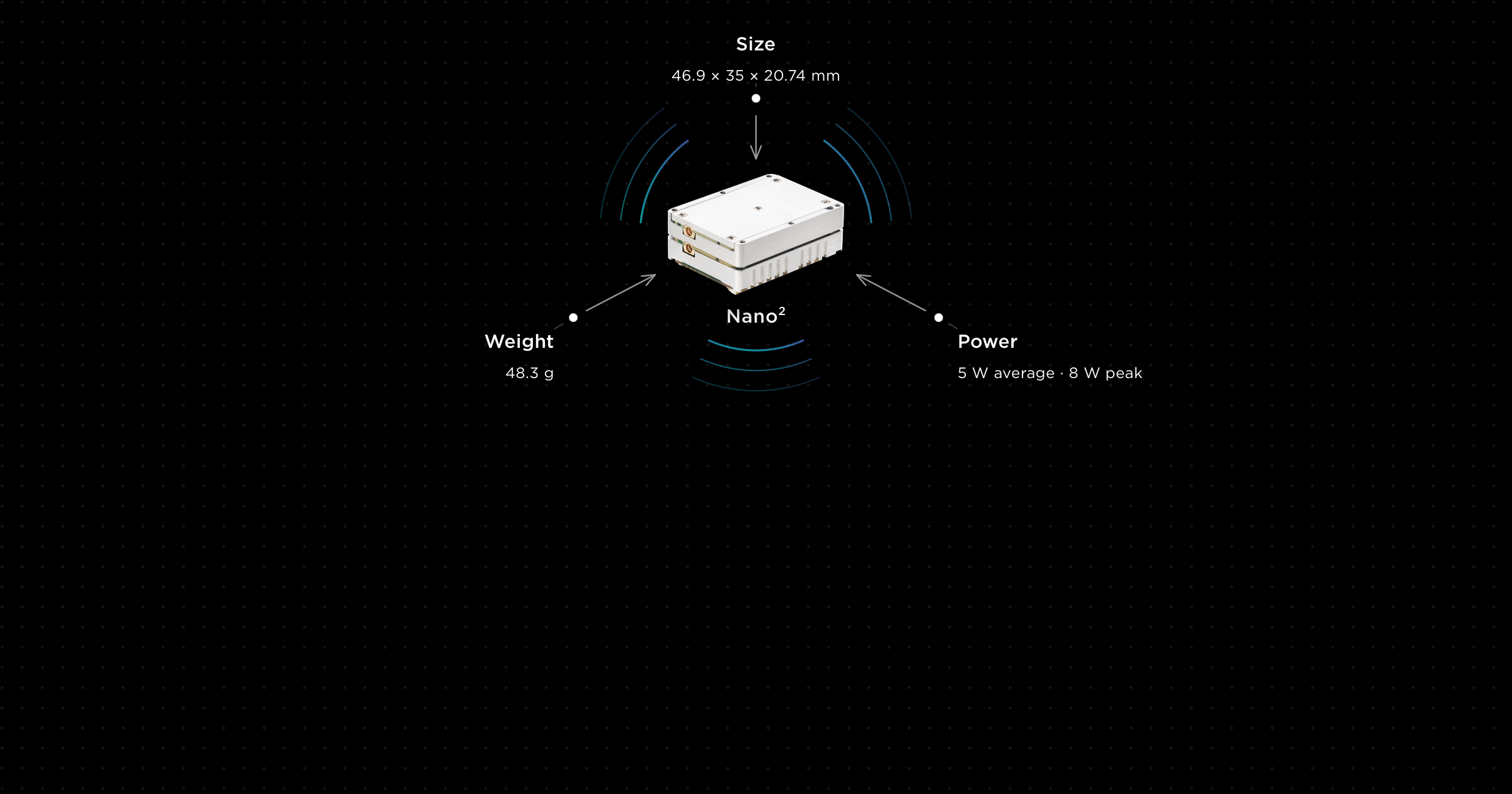
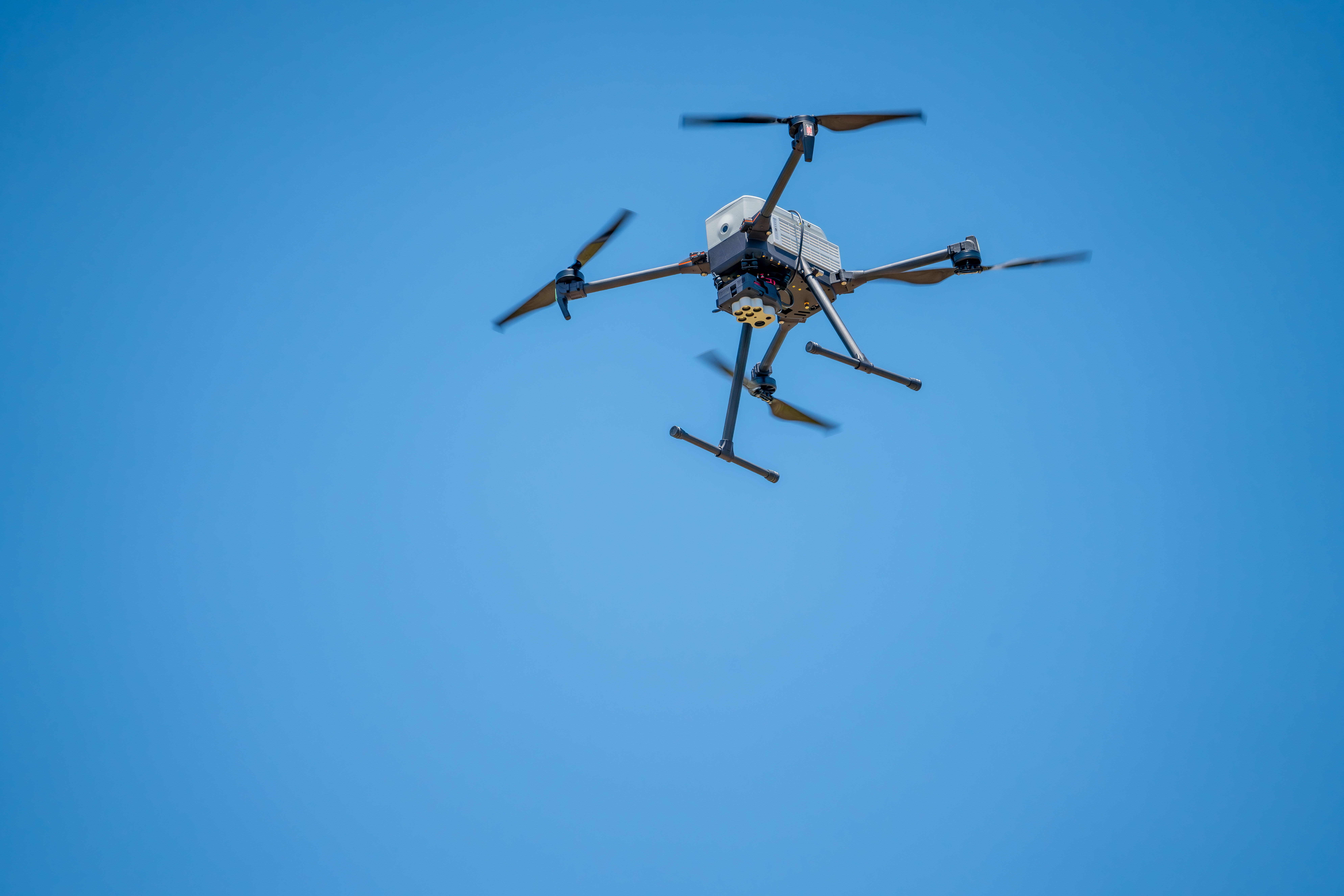
At Doodle Labs, we match compliance with capability. Mesh Rider radios deliver low-latency, long-range mesh networking with patented band-switching and anti-jamming resilience for contested environments. Our mini and nano2 form factors are light enough for the smallest Group 1 and Group 2 platforms – routinely streaming full-HD video well past 100 km. And they’re fielded today: integrated into platforms from PDW, Teledyne,RedCat-Teal and deployed on the front lines in Ukraine.
When procurement timelines are tight and program eligibility is non-negotiable, the datalink shouldn’t be the variable that puts approval at risk. Our radios and drone components are NDAA-compliant, Blue UAS-cleared, drone dominance-ready, and actively fielded – so compliance is one thing you don’t have to engineer around.
Learn more at www.doodlelabs.com.