


For most of the past decade, one of the most effective drone communications architectures was also one of the simplest.
First-person view (FPV) drones carried the drone racing scene, played a central role in the hobbyist boom, and eventually found a place in serious commercial and defense applications.
In this post, we’ll look at how the technical tradeoffs between analog and digital FPV links have evolved, and what that means for drone OEMs making communications decisions today.
Why Analog FPV Worked
Analog FPV didn’t persist by accident. Its architecture matched the operational model it was built for: one pilot, one aircraft, and one screen.
A continuous analog signal offers a direct path from camera to operator. It requires no complex network stack, no compression pipeline, no IP routing, and minimal processing overhead.
It delivers very low glass-to-glass latency and fails reasonably gracefully, with images getting noisy, static increasing, and the signal degrading in ways pilots could read and respond to.
When the operational unit is a single human flying a single airframe within radio line of sight, a dedicated point-to-point video relay is a compromise that worked for the common scenarios. Analog endured because it was inexpensive, and it fit the job to be done, delivering what FPV pilots cared about most, immediacy, predictability and simplicity
Mission Profiles have Changed Dramatically
Today, the jobs to be done for FPV drone makers have changed dramatically, and as mission profiles have changed, drone OEMs are identifying the need to shift architectures to meet the needs of their end-user and operator customers, particularly in high-stakes defense scenarios.
The transition that’s happening isn’t about digital systems having better image quality though that is a reality, it’s that the underlying mission models require way more than aircrafts with a camera.
Drones and unmanned systems have become flying sensor-compute platforms that run autonomy software, carry IP-native payloads, and have the ability to operate as part of a larger system that spans air, ground, and maritime assets.
FPV drones today need way more than a single video stream to a single operator. The requirements now extend to command and control traffic, telemetry, sensor data, AI outputs, and coordination with other vehicles, meaning that drone OEMs need to do way more than point-to-point video relay.
The Entire Ecosystem is Adapting
The rest of the stack has already made this shift. Flight controllers, autopilots, companion computers, payloads, perception models, and mission software are all digital and increasingly speak IP. In that context, an analog video link becomes the last non-IP component in an otherwise digital machine.
That doesn’t make analog obsolete across the board. There are still missions where its simplicity can be the right call, but it does mean that analog is no longer as well aligned with where unmanned systems are headed in defense context. As programs like American Drone Dominance and other similar programs in allied nations push OEMs to craft new systems or evolve existing architectures, price pressure leads some to still consider analog, while others are actively shifting away to ensure they adapt to the evolving scopes.
The Latency Argument in Context
The analog community’s strongest argument has always been latency, and it’s a valid one particularly for a single pilot flying a fast aircraft through a narrow course or into a high-risk terminal approach. Low glass-to-glass latency matters for those applications.
But latency has always been a proxy for a broader question: how much useful information can the link deliver, how reliably, and how well does it hold up under real operational pressure?
Viewed that way, the comparison changes. An analog FPV link spends its spectrum budget delivering one image to one viewer on a fixed channel, typically unencrypted.
A digital network link can carry video, command and control, telemetry, payload data, and coordination traffic over a shared infrastructure. It can encrypt the data stream, support multiple viewers, feed onboard compute, and adapt its behavior through routing, channel selection, or frequency agility when the RF environment degrades.
Operational experience in modern conflicts is reinforcing this. Electronic warfare environments have exposed the limits of fixed, easily detectable links. The window during which a given frequency remains usable has shortened considerably in contested environments.
Drones can become ineffective not because the airframe failed, but because the communications layer no longer survives the operating environment. Frequency agility, interference tolerance, encryption, and electronic warfare resilience have moved from premium features toward baseline requirements.
Digital FPV as Part of the Network Stack
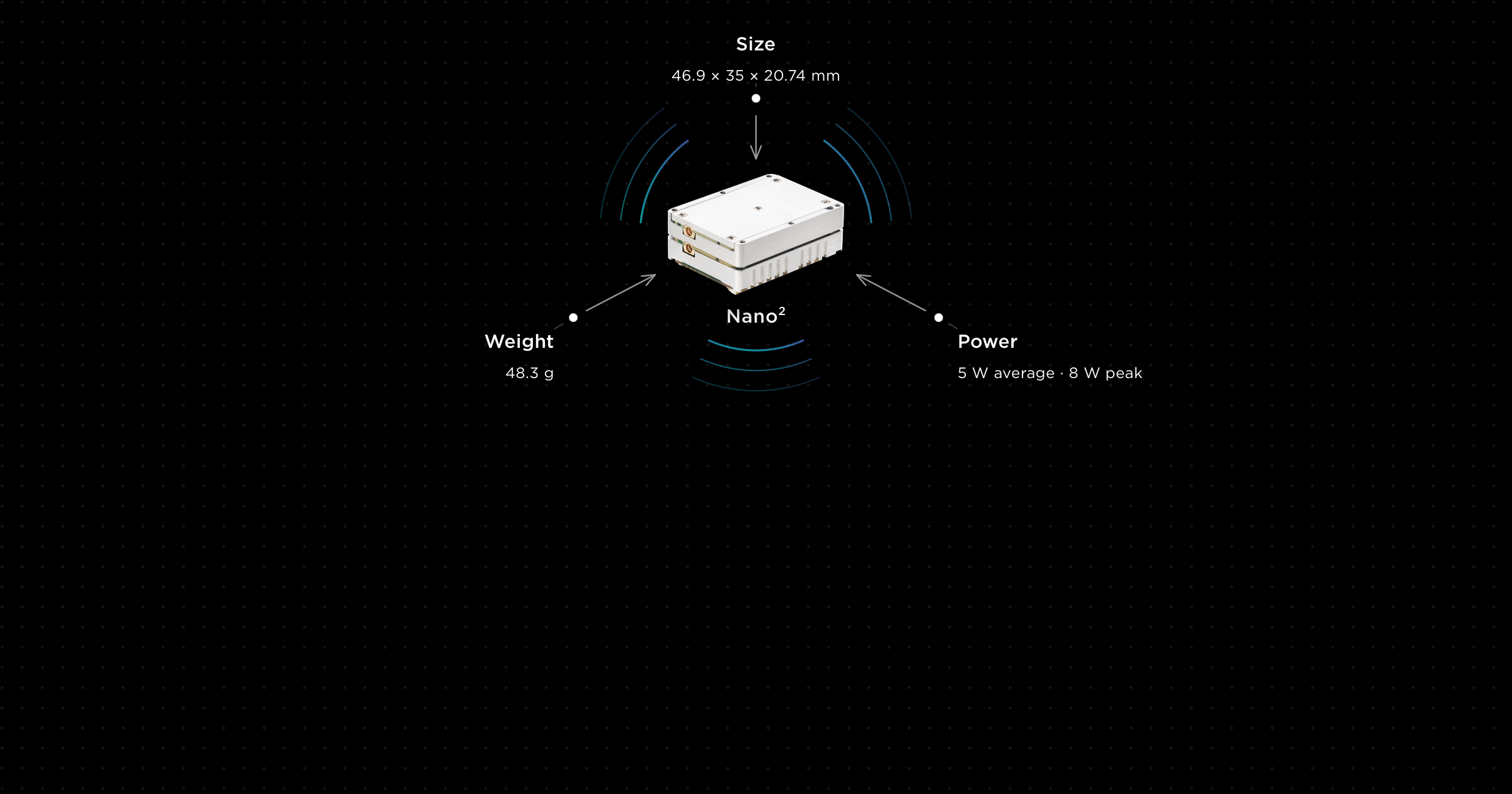
Modal AI’s FPV ecosystem illustrates the pattern. Its VTX air unit and VRX ground unit are built around digital video workflows, and ModalAI configurations use Doodle Labs modems as part of the communications path.
Doodle Labs and ModalAI have continued to develop integration between Mesh Rider Radios and the VOXL autonomy stack, specifically to enable this kind of unified architecture.
Once FPV video travels over an IP network, it becomes data. It can be encrypted, recorded, and viewed across multiple stations. It can be routed through the same infrastructure carrying command and control and made accessible to onboard autonomy systems or downstream mission tools. The pilot’s view stops being a closed circuit and becomes one data flow on a shared network. The radio, in this model, is not an accessory bolted beside the camera. It’s the network layer the autonomous system runs on.
Four Trends Worth Watching
Over the next several years, four trends will determine how quickly the analog-to-digital transition advances:
- First, digital glass-to-glass latency will continue to improve, while adding capabilities analog cannot easily provide such as encryption, multiple simultaneous streams, richer data handling, and native integration with IP-based systems.
- Second, one-to-many operations will become more common. A single operator managing multiple semi-autonomous aircraft needs an architecture that supports multiple modes, multiple data types, and dynamically changing mission roles.
- Third, electronic warfare resilience will move from a differentiator to a baseline requirement. Frequency agility, interference tolerance, routing, and encryption will matter as much as range or throughput in most serious deployment contexts.
- Fourth, procurement language from ministries of defense will continue to evolve. Programs will increasingly specify network behavior rather than video link specs. Programs will identify requirements for throughput under interference, node count, relay capability, security profile, latency under load and more. When that shift is complete in procurement language, it will reflect a transition that will have already happened in the field.
What this means for OEMs
The practical takeaway is straightforward: the radio selection decision for a modern unmanned platform is not a peripheral choice about video quality. It’s a foundational decision about the network your system will operate on.
Analog FPV served its era well. It gave pilots the immediacy and control they needed when the mission was one aircraft, one operator, and one video feed.
The current generation of missions looks different. The unit of operation is shifting from the individual aircraft to the networked system. OEMs that account for that shift early in their communications architecture selection, will be better positioned as the operational requirements continue to develop.
For more on how Doodle Labs approaches communications architecture for autonomous systems, visit doodlelabs.com/technology