


Radio selection for drone programs tends to start with a spec sheet comparison: Data rate, range, weight, frequency band, price.
Those numbers matter, but based on our experience, framing the comparison just in that way is the wrong place to start for drone OEMs.
Two radios with nearly identical specs can be the right and wrong answer for the same program depending on mission profile, threat environment, target markets, and how the platform is expected to evolve.
Getting it right the first time means working through the actual mission requirements is just as important as evaluating hardware. This guide covers the questions worth asking, the architecture decisions that follow from the answers, and the real costs of skipping the process and discovering gaps later.
Start with the mission, not the radio
The datalink’s job is to support the mission. That sounds obvious, but many radio selections start with hardware capabilities and work backward to whether the mission fits. The more reliable path is the reverse: define what the mission requires, then ask which radio architecture meets those requirements.
A few questions that should be answered before opening a datasheet:
What does the link need to carry?
Command and control traffic has modest bandwidth requirements. A telemetry link for a fixed-wing at moderate range can run comfortably on a low-throughput connection. A real-time video feed from a sensor payload, particularly a high-resolution or multi-sensor payload, requires significantly more.
A platform that carries both, or that is expected to support operator-in-the-loop control alongside autonomous flight, needs a link architecture that can handle concurrent traffic types without degrading either. The answer to this question establishes a floor on required throughput that eliminates a large portion of the market before any other filter is applied.
What is the actual operating range?
Nominal range figures on datasheets are typically measured under favorable conditions: clear line of sight, low interference, specific antenna configuration, optimal altitude.
Real-world range in operational conditions is lower, sometimes substantially. OEM engineering teams should work from a link budget that accounts for the actual operating environment, including terrain, built-up areas, antenna placement constraints on the airframe, and any regulatory limits on TX power (transit power) in the target market. The range number that matters is the one that holds under operational conditions, not the one in the product brochure.
Does the platform operate BVLOS, and how autonomously?
Beyond visual line of sight operations impose different link requirements than VLOS missions. At BVLOS ranges, link latency and reliability become harder to manage, and the consequence of a dropped link is more severe. Highly autonomous platforms can tolerate link interruptions that would be unacceptable for operator-in-the-loop control, but they still require reliable telemetry and command authority. Programs targeting BVLOS certification also face regulatory requirements for link reliability that need to be reflected in the radio selection, not addressed after the fact.
What is the threat environment?
A commercial inspection platform operating in uncontested airspace has a different RF threat profile than a defense or dual-use platform that may operate in environments with interference, jamming, or deliberate RF attack. The answer to this question determines how much the radio architecture needs to invest in frequency agility, spread-spectrum operation, adaptive power management, and electronic protection features. Overbuilding for EW resilience on a program that doesn’t need it adds cost and complexity. Underbuilding for a program that does need it creates a mission-critical vulnerability that cannot be patched after qualification.
Architecture decisions that follow from requirements
Once the mission requirements are clear, the architecture decisions follow. These are not independent choices; they interact with each other and with the mission requirements in ways that require judgment rather than following rules.
Mesh versus single link
Point-to-point links are simpler, lower-latency in single-hop configurations, and appropriate for missions where the platform is always in direct range of a single ground station. Mesh networks add complexity but provide capabilities that point-to-point architectures cannot: multi-hop routing through relay nodes, simultaneous links to multiple ground stations or assets, and network-level resilience that maintains connectivity when individual links degrade.
For programs operating multiple platforms, or missions that require extended range through relay nodes, mesh architecture isn’t optional. For a simple single-platform mission with a ground station always in range, the overhead of mesh may not be warranted. The answer depends on the mission, not on which architecture is technically more capable.
Frequency band and spectrum strategy
Frequency band selection involves regulatory, performance, and supply chain considerations that interact in non-obvious ways. Lower bands provide better propagation through obstacles and around terrain at the cost of antenna size. Higher bands support smaller antennas and wider channels but are more susceptible to attenuation and line-of-sight dependency.
Regulatory allocations for UAS operations vary by country, which matters for programs targeting multiple markets. A band that is available and unlicensed in one jurisdiction may require licensing or be unavailable in another. Programs with international ambitions should map band strategy against the regulatory landscape of their target markets before committing to a hardware configuration, not after.
EW resilience requirements
Frequency hopping, spread spectrum, and adaptive channel management are standard features on radios designed for contested environments. The relevant question is not whether these features are available but whether the specific implementation performs adequately in the interference and jamming scenarios the platform is likely to encounter. Vendor claims about EW resilience vary in specificity and in how they are measured. Engineering leads evaluating radios for defense or dual-use programs should ask for test data rather than feature descriptions and should define the scenarios they care about before evaluating test results.
SWaP constraints and their downstream effects
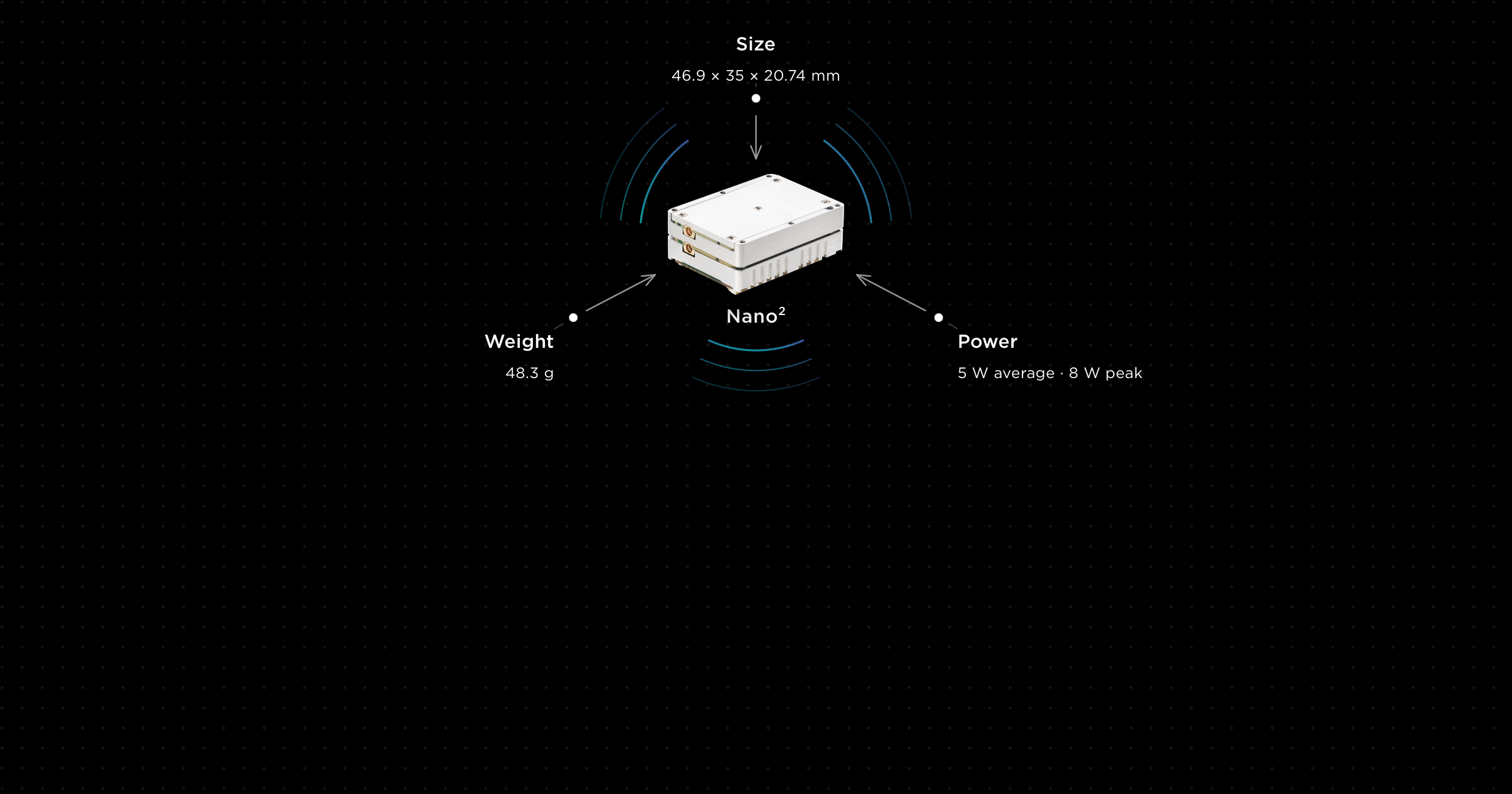
SWaP is a systems problem, not a component problem. The radio’s weight, power draw, and board area interact with antenna placement, battery sizing, and thermal management in ways that affect the entire airframe design. The right approach is to define SWaP constraints from the airframe, carry a realistic margin for integration effects, and evaluate radio options against those constraints before the mechanical design is locked. Discovering that the requirements for the selected radio’s antenna conflict with the payload bay layout is a resolvable problem at the design stage and an expensive one after the mechanical design is complete.
Certification and regulatory fit
The radio is a certificated component in markets that require type approval, spectrum licensing, or compliance certifications such as NDAA and Blue UAS. These are not considerations that can be deferred to the end of the hardware selection process. ITAR classification affects export logistics across the full program lifecycle, not just the initial purchase.
NDAA compliance is a binary requirement for programs with government customers or integrators. Blue UAS alignment has direct bearing on whether a platform can be procured by U.S. defense customers without additional qualification steps. These requirements should be explicit filter criteria at the start of the selection process, not discovered during contract review.
The cost of getting the selection wrong
Radio selection errors are expensive. They are also common, because the costs tend to be invisible at the evaluation stage and highly visible later in the program when fixing them is much harder.
Late-stage redesign
A radio that passes initial evaluation but fails to meet requirements during integration or qualification creates a redesign event. Depending on how far into the program the failure surfaces, re-qualification of an alternative radio can involve repeating integration work, rewriting software interfaces, re-running environmental and RF testing, and in some cases modifying the airframe to accommodate a different form factor or antenna configuration. The cost of a redesign can further compound as programs that drone OEMs participate in reach maturity. In these cases, the stakes can be higher, because a radio change at the prototyping stage is a manageable engineering task, but the same change during pre-production qualification or post-production can be a program-impacting event.
Blown SWaP budgets
A radio that is slightly too heavy, slightly too power-hungry, or slightly larger than the design assumed creates cascading effects across the airframe. The battery gets heavier to compensate for higher current draw. The endurance target gets revised down. The mechanical team revises the frame to accommodate the board. Each adjustment creates pressure on adjacent subsystems. SWaP overruns compound in ways that make the original radio selection look like a small error with large consequences.
Failed qualification and missed timelines
Certification timelines are set based on the expected qualification scope. A radio that introduces unexpected compliance requirements, whether ITAR classification that wasn’t anticipated, a spectrum certification that the program did not plan for, or an NDAA exception that requires documentation across the supply chain, extends the certification timeline in ways that back up into delivery commitments. Program managers who discover compliance gaps during qualification rather than during radio selection absorb the schedule impact at the least forgiving point in the program.
Capped mission adaptability
A radio that is adequate for the initial mission profile, but that doesn’t support the next version of the platform creates a premature architectural constraint. Programs that begin with a basic inspection mission and evolve toward swarming, BVLOS autonomy, or contested-environment operations frequently discover that the original datalink selection did not anticipate those requirements. Re-qualifying a new radio for an evolved mission is costly. Selecting a radio architecture that supports the likely evolution of the program is not.
Links that drop when it matters most
A link that performs adequately in testing and degrades in operational conditions creates a reliability problem that is difficult to diagnose and expensive to fix. Interference environments, multipath conditions, and thermal stress in operational use are harder to replicate on a test bench than RF performance in open-air conditions. Programs that do not stress-test the link against their actual operating environment during selection may not discover the gap until the platform is in the field.
How to get it right the first time
The pattern across all these potential issues is the same: requirements that were not surfaced early enough, architecture decisions that were made without the right information, and a hardware selection that locked in constraints before the downstream effects were understood.
Getting it right the first time means working through those requirements before the hardware decision is made, with someone who has seen these failure modes before and can map the program’s specific situation to an architecture that avoids them. This conversation does not need to take long. It needs to ask the right questions and answer them honestly against the program’s actual constraints, not a generic use case.
Doodle Labs’ sales engineers work with OEM engineering leads, systems architects, and program managers at exactly this stage. The goal is to identify the requirements that constrain the architecture, surface the tradeoffs that will matter on this specific program, and recommend a configuration that is calibrated to the mission, the market, and the timeline. That consultation is available before any commitment is made.
Getting the radio selection right at the start is substantially less expensive than correcting it later.
Start the conversation now with our sales and engineering teams: doodlelabs.com/contact