


A look at how Doodle Labs’ GaN bidirectional amplifier raises Mesh Rider transmit power on demand, and where it fits in a deployment.
Long-range, jam-resistant links usually come down to one variable. That variable is how much signal reaches the receiver relative to the noise and interference around it, commonly called the signal-to-jamming ratio. Doodle Labs’ Mesh Rider® radios already address the ratio through frequency agility, as Sense EW resilience shifts bands and channels in under 100 ms. Since dual Radio configurations run two independent bands, defeating one never defeats the link.
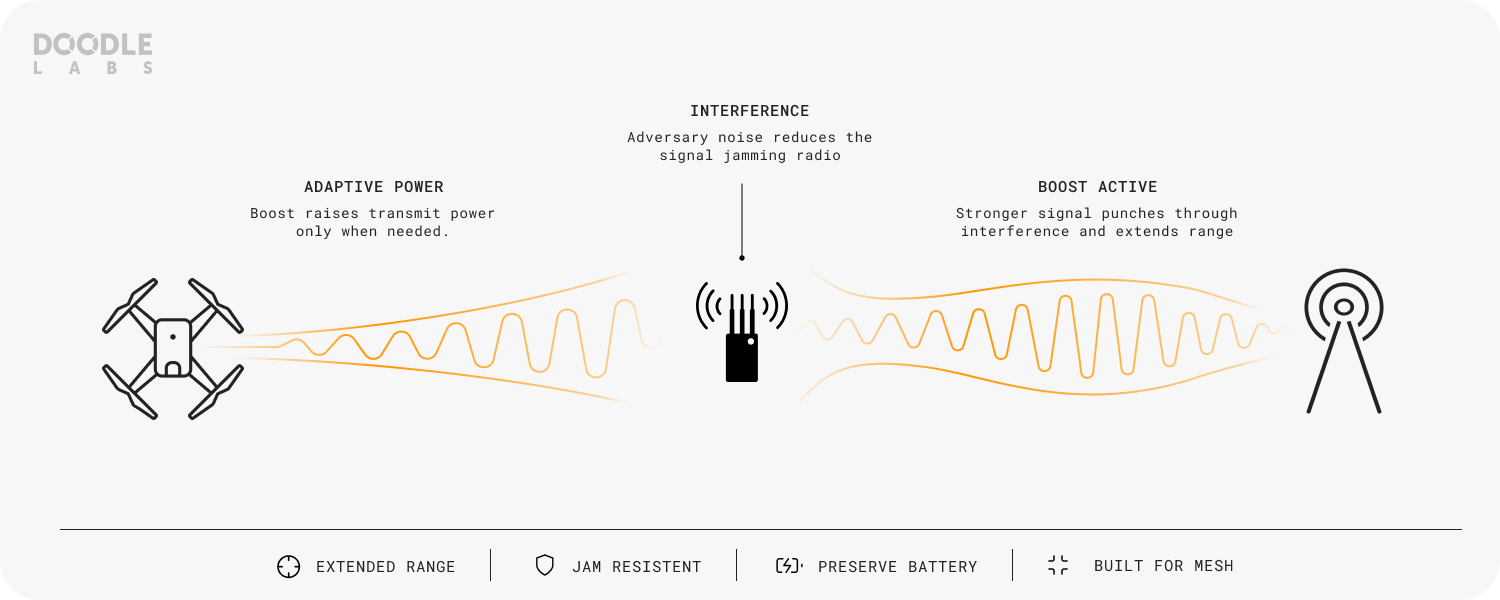
Our new Boost addresses the same ratio in a third way i.e. by raising transmit power directly at the radio. This blog looks at how the C-Band variant of Boost works. It also covers how the power-management mode protects flight time, and where the Boost belongs in a Mesh Rider deployment.
Range, Jamming, and the Signal-to-Jamming Ratio
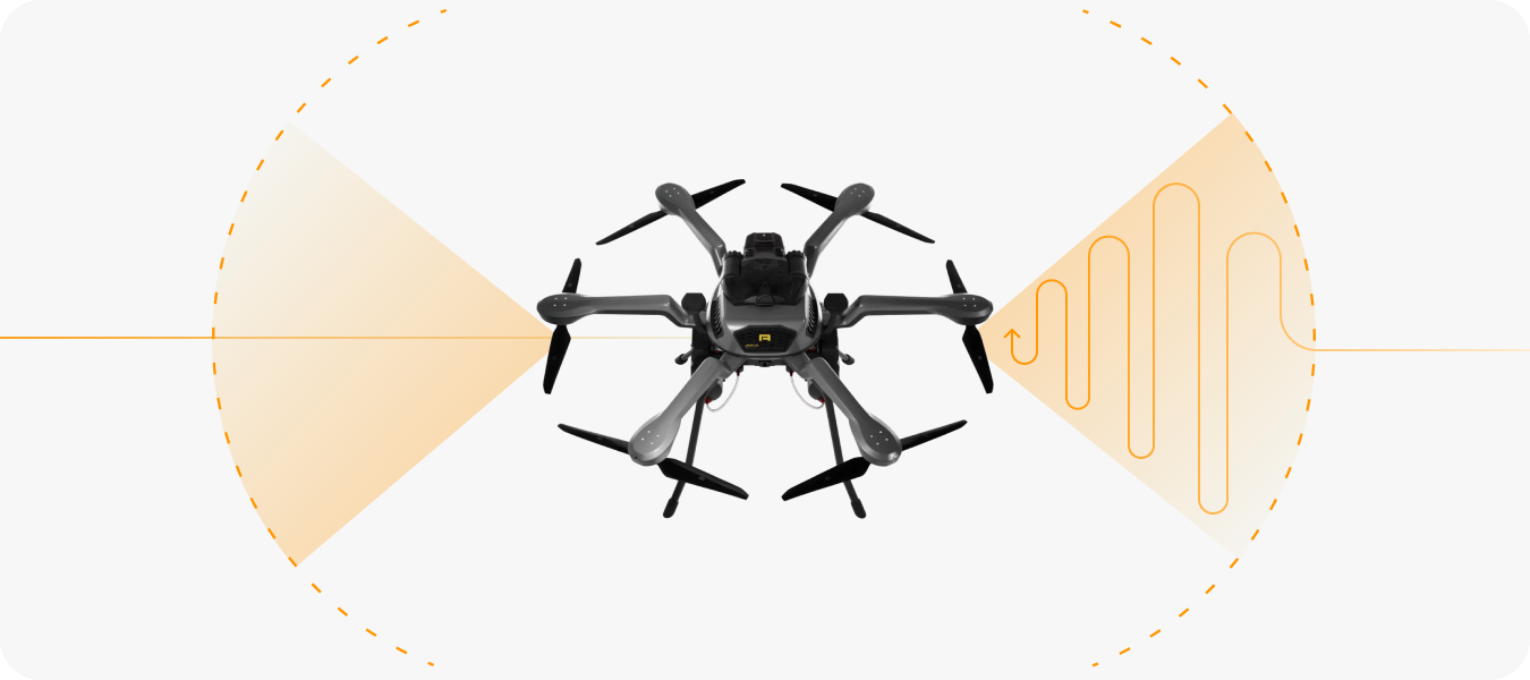
When a jammer beats a radio’s native link budget, the practical options become limited. A team can either change the operating band, or close the distance, or increase the transmit power. Boost targets the third option directly. By raising output power at the radio, Boost increases the signal-to-jamming ratio the receiver sees. That increase extends the radio’s effective range while pushing back against jamming.
Defeating a Boost-equipped link then requires an adversary to bring more jamming power, field a more capable jammer, or move closer to the target. Each of those options carries a real cost in money, weight, or position. Boost also seamlessly compounds with Sense and Dual Radio rather than replacing either of the capabilities. A link that shifts bands and runs on two independent radios is already hard to pin down. Add higher transmit power, and it becomes harder still.
Inside the C-Band Amplifier
Boost is a gallium-nitride (GaN) bidirectional amplifier, shipping as a two-variant line covering S-Band and C-Band separately. That way, it attaches to an existing Mesh Rider install base without requiring a new radio purchase. The C-Band variant, model BDA-4464-04-22O2, covers 4,400 to 6,400 MHz, and raises maximum transmit output to 36 dBm (4 W) across a 2×2 MIMO configuration. It also adds up to 13 dB of transmit gain and roughly 8 dB of receive gain.
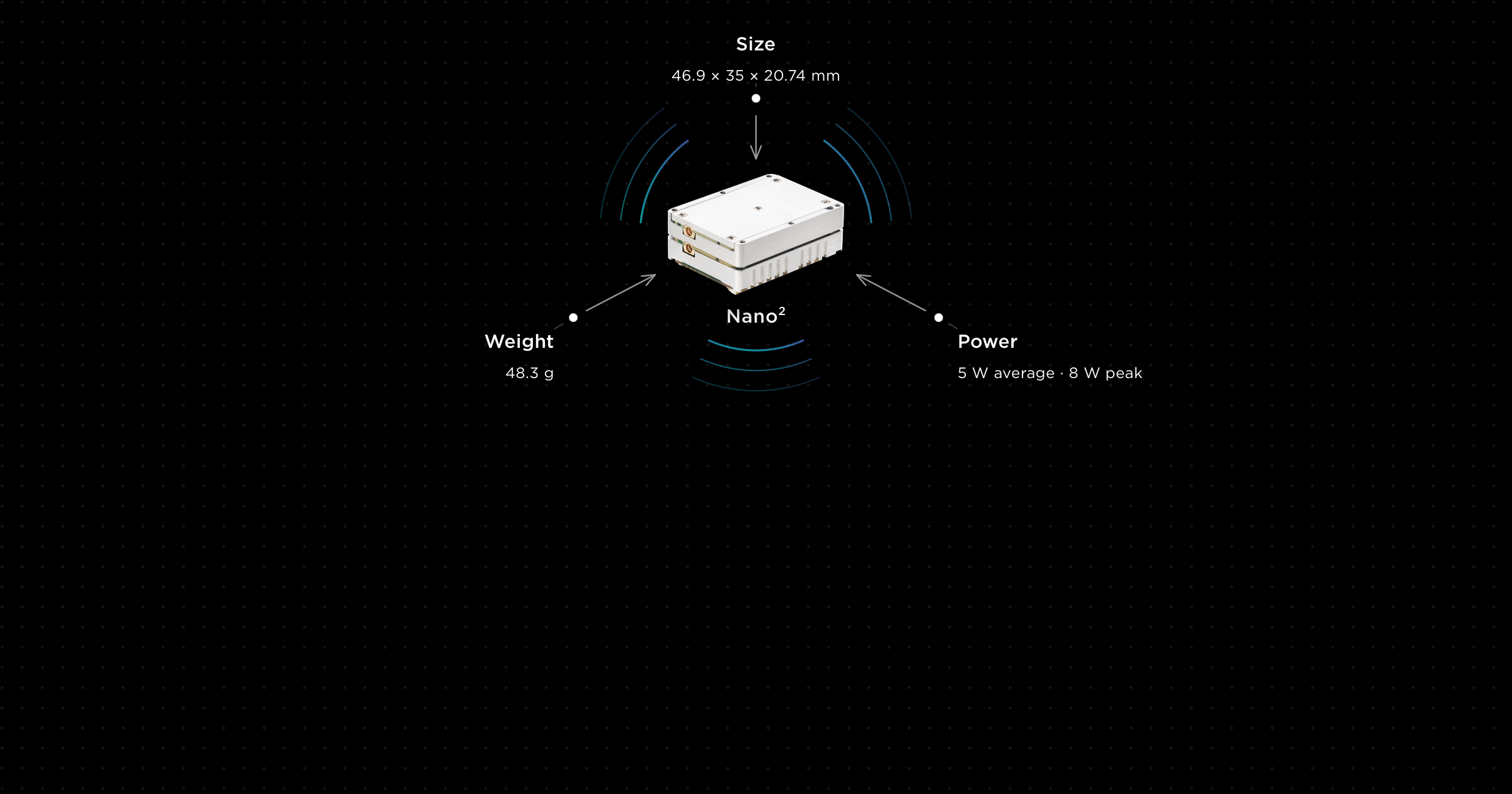
Automatic Tx/Rx switching happens in about one microsecond, so the amplifier does not introduce a perceptible handoff delay. The C-Band module ships at 46.9 x 35.0 x 20.74 mm without a heatsink and weighs 147 grams. Passive and active cooling configurations are both available, depending on the expected duty cycle.
Smart Bypass Mode and the Power Budget
On a small airframe, every watt spent on RF competes directly with flight time. Boost manages that tradeoff with a software-controlled Smart Bypass Mode, wherein the amplifier stays disengaged, and platform power draw stays near 1.2 W, whenever the native link margin is already sufficient. Once range or jamming conditions demand extra output, Boost engages automatically. Platform draw then rises toward 4W at full transmit power, and no operator action is required in either direction.
The said behavior distinguishes Boost from a blunt, always-on power increase. A fixed high-power amplifier spends battery margin for an entire mission, whether the link needs it or not. Smart Bypass Mode spends that margin only when the link actually requires it.
Where Boost Fits in a Mesh Rider Deployment
The C-Band Boost variant is built to pair with C-band-capable Mesh Rider radios, including the radio that runs NATO C-band and U.S. government bands in a Dual Radio configuration. Doodle Labs also offers a Ruggedized (R) form factor on a per-customer basis, along with custom frequency ranges and output power levels on request. Neither is a standard catalog configuration, so integrators should confirm exact requirements with Doodle Labs before finalizing a bill of materials.
This is not the first time a Mesh Rider deployment has reached a long range with an external amplifier. Doodle Labs has previously demonstrated performance out to 330 km using third-party amplifiers. Those solutions carried real tradeoffs in size, weight, cost, and supply availability. Boost was built specifically for drone platforms to close that gap without the same compromises.
Boost C-Band Specifications
| Spec | Boost (C-Band) |
| Model | BDA-4464-04-22O2 |
| Frequency range | 4,400–6,400 MHz |
| Max Tx output | 36 dBm (4 W), 2×2 |
| Tx gain | Up to 13 dB |
| Rx gain | ~8 dB |
| Dimensions | 46.9 x 35.0 x 20.74 mm (without heatsink) |
| Weight | 147 g (without heatsink) |
| Power input | 5.5–30 VDC |
| Switching | Automatic Tx/Rx, ~1 µs |
Talk to Doodle Labs About Boost
Integrators mounting radios at a distance from the antenna, or programs operating at extended standoff distances, can start with the Boost product page. It has full RF specifications and a datasheet. Doodle Labs team can also confirm which Mesh Rider radios and frequency variants pair with a given Boost configuration for your platform. Contact Doodle Labs to start the conversation.