


Every subsystem on a small drone competes for size, weight, and power. The flight controller needs a processor headroom. The payload needs volume and power. The battery must be large enough to meet endurance targets without pushing the airframe past its weight limits. Each of these tradeoffs is real, and experienced teams manage them through iteration.
The communications radio is different. By contrast, OEMs can scale back other subsystems when the SWaP budget tightens. Engineers can reduce a processor’s clock speed, replace a sensor with a lighter one, and lower a camera’s resolution. However, they cannot scale back the radio in the same way. Range, throughput, and RF resilience all push in the same direction. They demand more transmit power, larger antennas, more RF chains, and more space on the board. A radio that cannot transmit enough power at the right frequencies will fail at preserving the mission capability.
This asymmetry makes radio SWaP optimization the hardest tradeoff in the stack: each gram matters, and OEMs cannot compromise communications performance. This blog explains why radio requirements impose such tight constraints and how specific issues emerge during system design and deployment.
Why the radio competes harder than other subsystems
Part of the problem is that RF does not scale the way digital electronics do. In contrast, compute keeps shrinking with each process node, while antennas and RF output do not. Wavelength sets the size of an efficient antenna. The link budget sets the transmit power needed to close a link at a given range. Neither bend to a smaller chip. Consequently, the miniaturization that works elsewhere on the platform hits a hard floor on the radio.
Most SWaP analysis treats power draw as a steady-state number. For the radio, that misses something. The link budget sets the required transmit power. That budget spans path loss at range, the receiver noise floor, the required SNR, and margin for interference and fading. The link budget does not negotiate. As a result, when the power budget forces transmit power below what the link needs at range, the system sacrifices range.
Weight and volume compound the problem. Board space is another source of pressure. MIMO operation uses multiple transmitting and receiving chains at once to improve throughput and resilience. It requires multiple RF chains, PA stages, and antenna feeds. Each chain adds a board area and power draw. On a large platform, that cost is reasonable. On a 250-gram airframe, it is a real constraint.
Specific tensions showing up in practice
Transmit power versus battery endurance is the most direct tradeoff. Radio weight makes it worse in a way that is easy to miss. Every gram on the radio costs the platform twice. It counts as its own mass, and again as the energy the aircraft spends to keep that mass aloft. The radio then draws current on top of that. At the power levels needed for reliable links at 5 to 10 km, the transmit state draws heavily. It can be a meaningful fraction of the platform’s power budget. The result is either a heavier battery or less range than the requirement specifies.
Antenna placement versus payload volume shows up late in mechanical design and is expensive to fix. The RF ground plane, separation from other RF sources, and clear line-of-sight geometry all need space. They compete with the payload bay, the flight-controller stack, and the power board at the airframe center. Teams that treat antenna placement as a late decision often find that measured performance does not match the modeled link budget. The cause is usually interference or ground-plane effects that the datasheet never showed.
Teams building small platforms routinely underestimate thermal limits. A radio’s PA stages generate heat in proportion to output power and inversely to efficiency. A large platform has the thermal mass and airflow to manage that heat. A compact module in an enclosed bay, running at high duty cycle in a hot environment, can throttle transmit power to protect the PA. This reduces the link budget at exactly the moment the operator pushes range.
What good radio architecture recovers
The SWaP problem in drone comms is not mainly a miniaturization problem. It is an architecture problem. The question is not only how small the radio can be, but how much of a larger radio’s link budget, throughput, and resilience the design can recover without the size.
Efficient power management recovers range from the battery budget. A radio that scales transmit power to measured link quality draws less average current than one transmitting at maximum continuously. At close range the PA backs off; as the platform extends, power rises to hold the required SNR. Across a mission profile, the average current is lower than a fixed-power design,which feeds directly into system endurance.
Mesh architecture recovers resilience from the antenna tradeoff. In a mesh network, each node holds links to several others at once. If one link degrades through antenna geometry, interference, or obstruction, the network routes around it. Multi-band integration recovers spectrum flexibility without multiplying hardware. Historically, each added frequency band meant another radio chain, more filters, more mass, and more current. Doodle Labs’ patented multi-band Mesh Rider® technology instead spans multiple licensed bands (M1 to M6) in a single radio. Adding spectrum coverage no longer adds hardware. For a program, it keeps band count from becoming its own SWaP penalty, since one design can serve more regions without growing.
The Nano² as a reference design
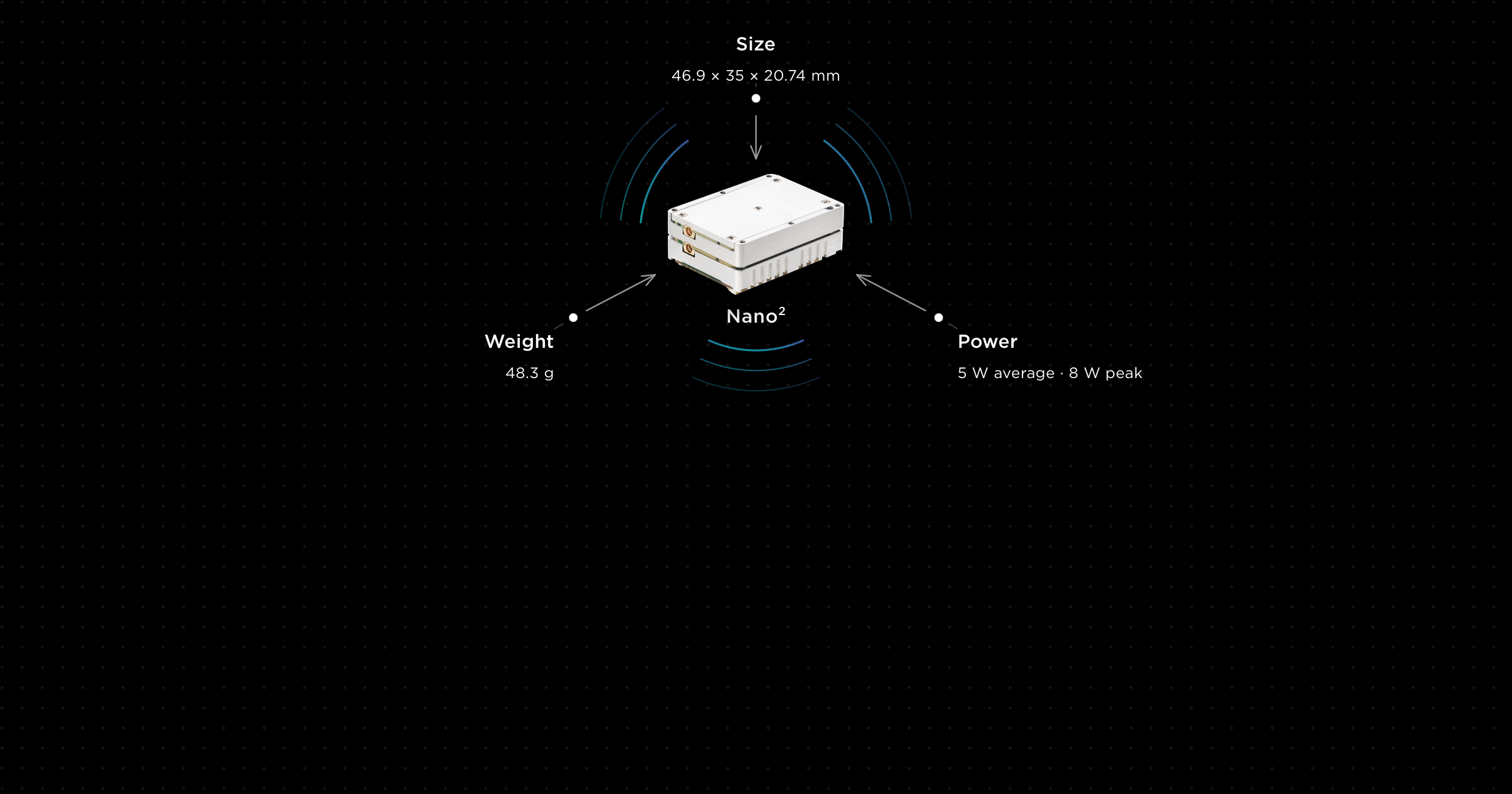
Doodle Labs’ Nano² is a concrete example of these choices at the small end of the SWaP range. The radio weighs only 48 grams and seamlessly fits within the payload budget of platforms in the 250-gram to 1-kilogram class. These platforms would otherwise be limited to single-chain radios with modest throughput and no spatial diversity.
Nano² carries the same 2×2 MIMO configuration as the larger Mesh Rider® Mini, meaning the RF architecture is not compromised to reach the smaller size.
The Nano² runs the same mesh stack as every other Mesh Rider® variant. Nano² is designed for the placement limits that small airframes impose on antenna integration. The module supports external antenna connection through a compact RF interface. The mechanical team can then position antennas around the airframe’s actual RF environment, rather than around a radio that dictates placement. As noted above, this placement decision has real downstream effects on measured link performance.
Treating SWaP as a systems problem
The teams that handle radio SWaP well bring the comms requirement into the design process early, alongside propulsion, battery, and payload. The radio’s link budget, transmit power, antenna placement, and thermal management all interact with airframe geometry, power distribution, and thermal architecture. These interactions are far cheaper to address at the requirements stage than during integration.
Radio architecture also has upstream effects on the rest of the system. A mesh-capable radio handles link diversity and multi-hop routing at the RF layer,reducing what the flight controller and ground-station software must do to manage link failures. A radio with dynamic power management lowers the worst-case current the power system must accommodate.
SWaP is a fixed budget. The real question is how much RF capability can be recovered within it. The answer depends more on architecture than on how small the radio can be made. The teams that build the best small drones design the radio around the physics it actually follows. They do not expect it to shrink like the rest of the electronics.
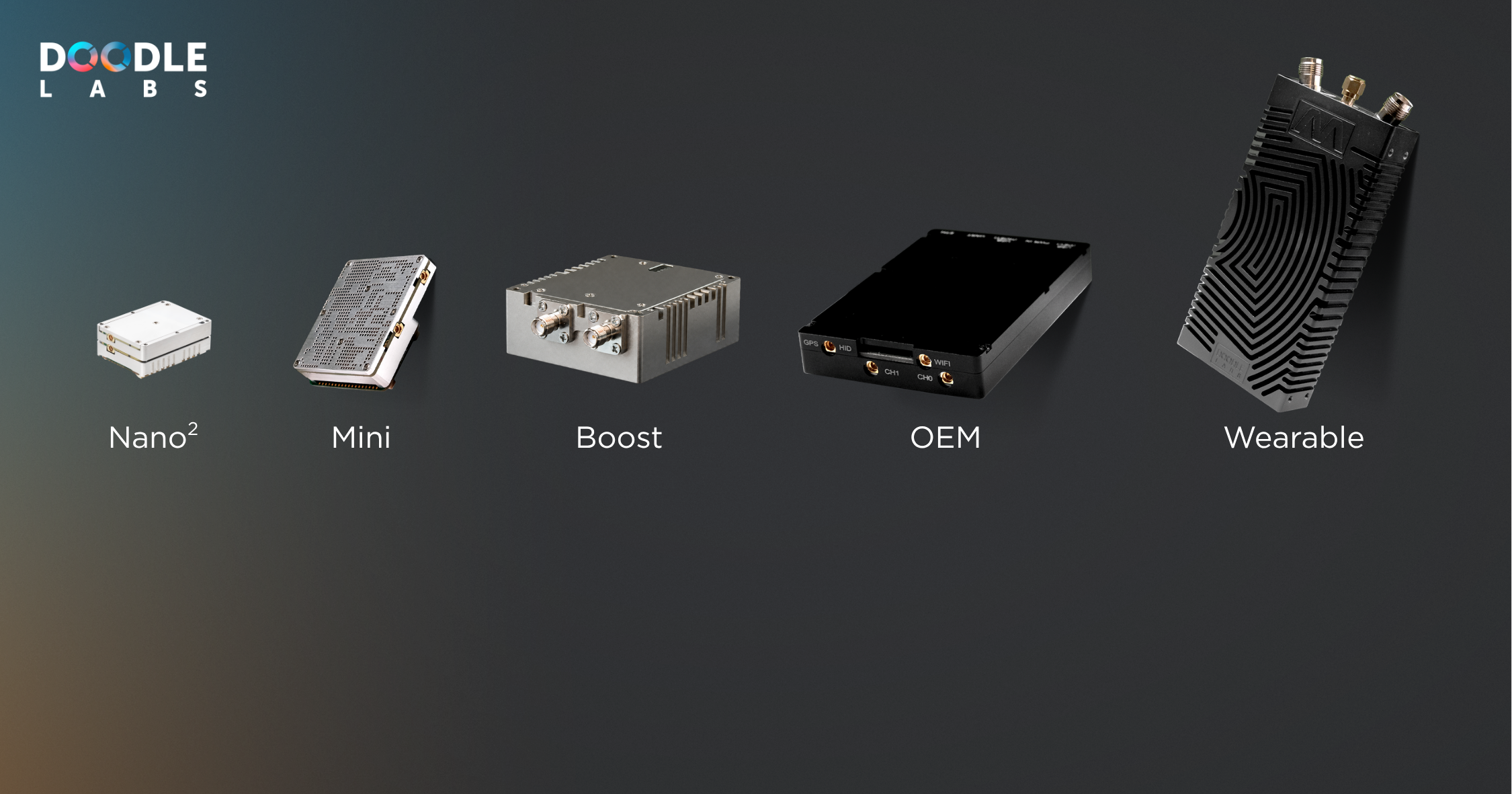
Learn more about Mesh Rider® form factors and SWaP specifications, and see how these choices fit a scaling program like Drone Dominance.