




4 minute read
This post, written by Doodle Labs CTO Nimesh Parikh, originally appeared on LinkedIn.
Over the years we have heard from numerous customers that our Mesh Rider Radios outperform the much more expensive competitor radios. These customers have done side-by-side shoot outs in varying challenging environments like range testing, penetration inside buildings, in NLOS conditions, in extremely noisy conditions inside a warehouse with large amounts of metal acting as RF reflectors, and also over-the-water transmissions.
In the beginning, every time we got such feedback, we would feel good, exchange high-fives, and think of them as lucky or one-off results. After all, these competitor radios are 2 to 4 times more expensive, so they must possess some performance advantages that we must be missing, right?
However, after such repeated feedback, we realized that these are not one-off instances and we took a deeper look into the issue. After carefully analyzing the available information, it became evident that all these MIMO radios provide excellent performance. The reasons for the performance edge enjoyed by Mesh Rider radios boils down to a few basic reasons:
1. Better Rx Sensitivity
This is a very important and critical criteria of a radio design. It is difficult to measure in the field and requires special measurement instruments. Having better Rx sensitivity is like having bionic ears that can pick up faint signals from afar and still being able to understand them. Having better Rx sensitivitybeats high Tx power, which is equivalent to shouting. You need to use a louder voice when talking to people with difficulty hearing. Additionally, more Tx power creates larger self-interference in the environment as the radios are asynchronously shouting at each other.
(Check out Jacob Hodges’ post from earlier this month for a great overview on the topic)
2. Signal Purity
On the Tx side, a very critical criterion (and one rarely discussed) is the purity of the signal called EVM (Error Vector Magnitude). It is the key metric used to evaluate RF transmitter performance, because it provides a consistent “yardstick” to characterize the transmitter and it encapsulates a wide range of possible impairments on the transmitter chain into a single measurement. It can be thought of as the clarity of the speech so that the listener can understand it better.
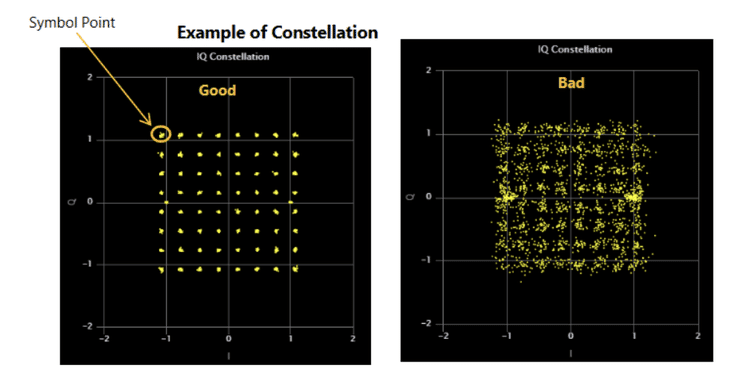
When the EVM is good, the constellations are well-defined and easy to understand by the receiver. However, for the bad EVM, the constellations are smearing into each other, making it difficult to decipher them by the receiver.
Due to non-linearities in the Power Amplifiers, the EVM deteriorates at high Tx power and at high temperature (Laws of Physics). It is equivalent of distorted sound when playing very loud music. The power amplifiers get saturated and distort the sound.
Our patented, hybrid SDR Multi-band technology is all about using the fine-tuned circuit and best filtering for each band to achieve the best performance. We also carefully calibrate each and every radio shipped to ensure that the signal purity is maintained at the highest level for each band.
3. Baseband Processing
Doodle Labs radios are based on IEEE 802.11n technology. It is one of the most advanced wireless communications technologies in the world. We further enhance the technology and make it suitable for targeted outdoor, long range use cases. The DSPs used in our baseband processor are pretty good at sniffing out information from the faint signals (high SNR). Our radios feature Spatial Diversity that provide 3 dBm boost to the Rx gain (that is 50% longer range!). This will only get better as we upgrade the Mesh Rider Radios to the latest IEEE 802.11ax (a.k.a 6G) technology. Watch this space …
A look at the actual performance of our customers, combined with these technical factors, really does de-mystify how our Mesh Rider Radios achieve longer range and more resilient performance at lower SWaP and lower cost than our competitors.